


Diatonic Chords
In any key there are 7 main chords - chords 1 through 7. With these chords you can play any song in any key.
The 7 main chords in the Key of C on piano.
In the 7 chords there are three types of chords. Major, Minor and Diminished.
How to build a Major chord on a piano.
How to build a Minor chord on a piano.
How to build a Diminished chord on a piano.
Here again are the finger shapes for the 7 main chords in the Key of C on the piano.
Also notice that I call the first chord I play a 1 chord instead of a C chord.
The 1 chord = C the 2 chords = D the 3 chord = E the 4 chord = F the 5 chord = G the 6 chord = A and the 7 chord = B
And last notice that the 1 chord is Major, the 2 chord is Minor, the 3 chord is Minor, the 4 chord is Major, the 5 chord is Major, the 6 chord is Minor and the 7 chord is Demineshed.
Now that this music theory is in your head its a great time to check out our diatonic harmony section to see why we changed the chord names to numbers.
On Guitar it's really easy to play all seven chords.
Here are the finger shapes for 7 chords in the Key of G on the guitar. The same guitar chord shapes apply to all keys. If you learn these 7 shapes you will be able to play any song in any key.. (and its really only 5 chord shapes!) This was by far the best guitar lesson I ever got. I'm so thrilled to pass it on.
The diatonic harmony section also works for guitars and all western tuned instruments. See why we changed the chord names to numbers.
Diatonic Harmony
Welcome to Diatonic Harmony - Diatonic Harmony the foundation of western music. The Diatonic Harmony chart shows a basic note or chord progression that takes mins to learn and is worth a lifetime of joy.
Diatonic Harmony: If we look at The Major Scale in the key of C (white keys on a piano) and we start on the C key and move up a note at a time C, D, E, F, G, A, B, C or we can think of those notes as numbers C=1, D=2, E=3, F=4, G=5, A=6, B=7, C=8 once we think in numbers we can use this Diatonic Harmony chart. If you hold down key 3 then chances are that the next note you want to press is 6 and then from 6 chances are you would want to move to 2 and so on. This of course is not set in stone but if you want to play along to your favorite song and you know what key its in then this chart helps you sound like you know what your doing.
Check out the Circle of Fifths to learn about Key Signatures and check out Wah Wah Guitar it has a video showing 7 chord finger shapes that lets one play any song in any key and if you use this chart and the seven finger shapes you will see how cool Diatonic Harmony is.
Diatonic Harmony Chart. If you hold down key 3 then chances are that the next note you want to press is 6 and then from 6 chances are you would want to move to 2. This is so simple yet so powerfull.

The Diatonic Scale uses 7 tones. You've heard - do, re, mi, fa, sol, la, ti before I'm sure. These 7 tones always sound the same in relationship to each other but there are 12 versions that change in pitch. You can sing do, re, mi, fa, sol, la, ti and then sing the same thing a little higher to get the idea. When you do sing it higher you will probably sing the next version a fifths higher than before. Imagen the first version you sing is in C. The next version that would sound best would be 5 tones higher at G Its kind of built in to how we humans hear western music and is explained by the Circle Of Fifths.
Diatonic Modes
There are seven Modes in a Diatonic Scale: Ionian, Dorian, Phrygian, Lydian, Mixolydian, Aeolian, and Locrian.

A Scale has 7 tones. if we start on the first tone of the Scale and play up 7 tones we wold be in the first mode C, D, E, F, G, A, B, C. If we would play the same Scale but start on the second tone it would be called another mode of the scale D, E, F, G, A, B, C, D. Pretty easy!
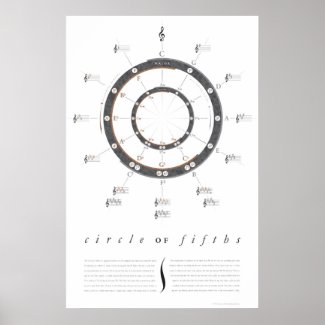
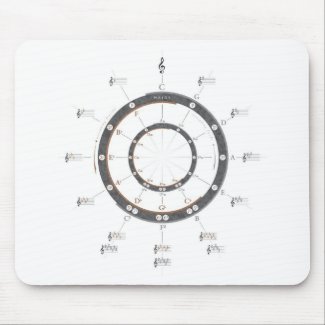
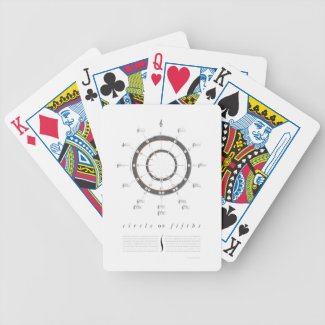
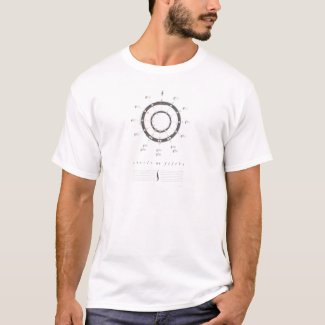
The Circle of Fifths is a useful tool for understanding the relationships between musical keys. For example, by starting on C major and moving clockwise around the circle, we can see that the next key is G major, then D major, and so on. This pattern is known as a "circle progression."
Using the Circle of Fifths to Create Harmonic Progressions
One of the most common uses of the Circle of Fifths in composition is to create harmonic progressions. A harmonic progression is a sequence of chords that creates a sense of movement and tension in a piece of music.The Circle of Fifths can be used to navigate between different keys and create smooth and cohesive harmonic progressions. For example, a common technique is to start in one key and then move to the key a fifth away. By using the Circle of Fifths as a guide, composers can easily navigate between different keys and create interesting and dynamic harmonic progressions.
Using the Circle of Fifths for Key Changes
Another powerful use of the Circle of Fifths in composition is for key changes. A key change is the process of moving from one key to another during a piece of music. Key changes can add a sense of drama and tension to a composition, and can also be used to create a sense of resolution at the end of a piece.By understanding the relationships between different keys on the Circle of Fifths, composers can use key changes to create smooth and cohesive compositions. For example, a common technique is to start in one key and then move to the key a fifth away, or to move between closely related keys.
Conclusion
The Circle of Fifths is a powerful tool that can help musicians and composers navigate the complex world of music theory and composition. By understanding the relationships between different musical keys and chords, composers can use the Circle of Fifths to create powerful harmonic progressions and key changes, and create dynamic and cohesive compositions. Understanding and using the Circle of Fifths is an essential step in becoming a skilled musician and composer.
The Circle of Fifths is a useful tool for understanding the relationships between different keys and chords. For example, by starting on C major and moving clockwise around the circle, we can see that the next key is G major, then D major, and so on. This pattern is known as a "circle progression."
Understanding the Relationships Between Keys
One of the most important uses of the Circle of Fifths for music students is in understanding the relationships between different keys. By understanding how different keys are related to each other, music students can navigate between different keys and create interesting and dynamic compositions.For example, music students can use the Circle of Fifths to understand the relationships between closely related keys, such as the relationship between C major and A minor. This knowledge can be used to create smooth and cohesive compositions that move between different keys.
Navigating Harmonic Progressions
Another important use of the Circle of Fifths for music students is in navigating harmonic progressions. A harmonic progression is a sequence of chords that creates a sense of movement and tension in a piece of music.By understanding the relationships between different keys on the Circle of Fifths, music students can use harmonic progressions to create dynamic and interesting compositions. For example, a common technique is to start in one key and then move to the key a fifth away, or to move between closely related keys.
Conclusion
The Circle of Fifths is an essential concept in music theory that is a must-know for any music student. It is a powerful tool that can help music students navigate harmonic progressions and key changes, and create dynamic and cohesive compositions. By understanding and using the Circle of Fifths, music students will have a solid foundation in music theory and be well on their way to becoming skilled musicians and composers.